
Executive Summary
This field report analyzes 6,084 recorded in-home sales appointments across 10 home services companies using TalkTrackr’s conversation intelligence platform to examine how the sequence and timing of information delivery relates to in-appointment buyer commitment.
The objective of this analysis is descriptive and diagnostic: to identify conversational structures associated with stronger sales outcomes, not to claim causal effects.
Key Findings
- Among appointments resulting in an in-appointment commitment, 87% followed a consistent six-stage conversational sequence, compared to 31% of appointments without such commitment.
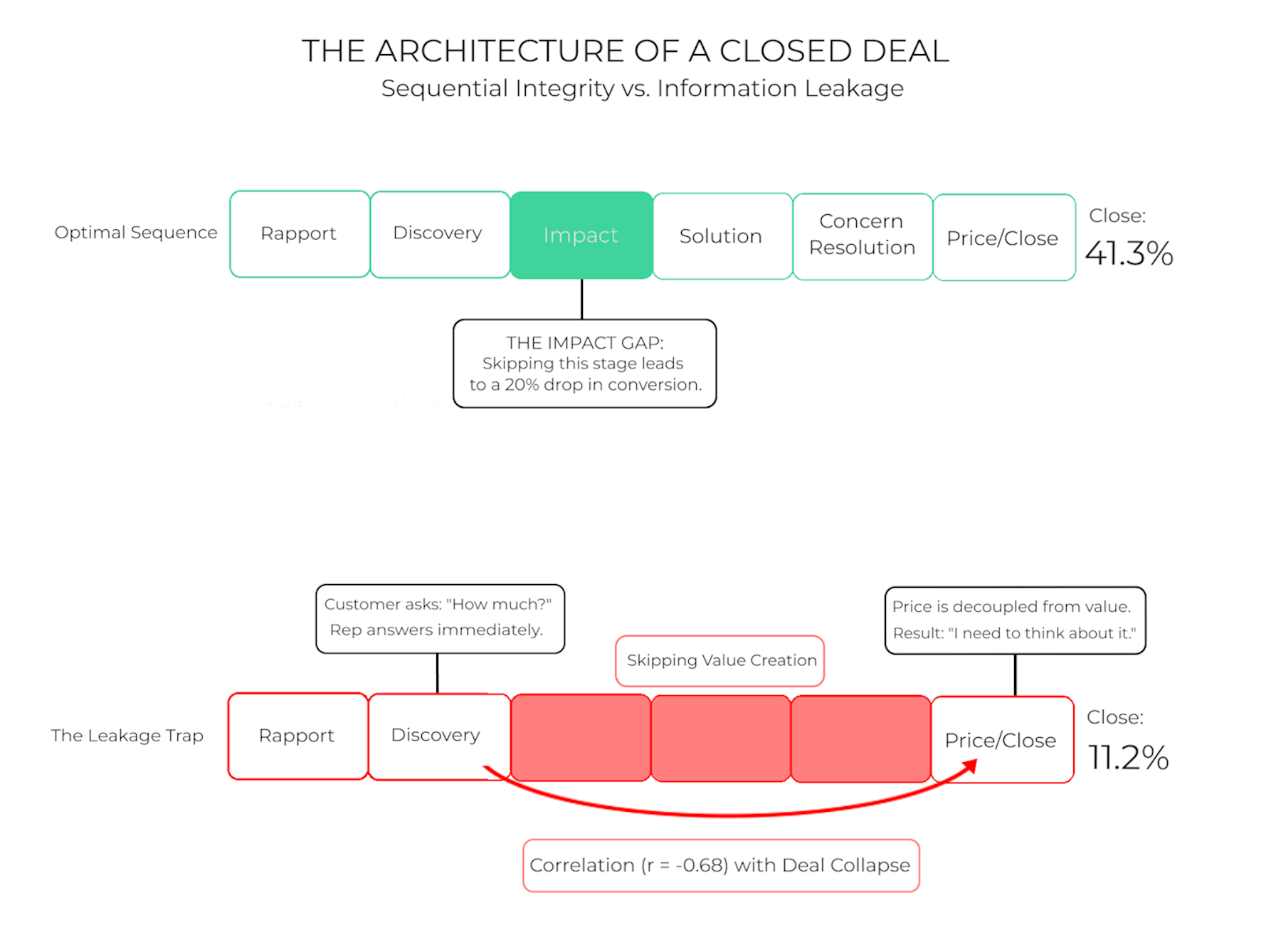
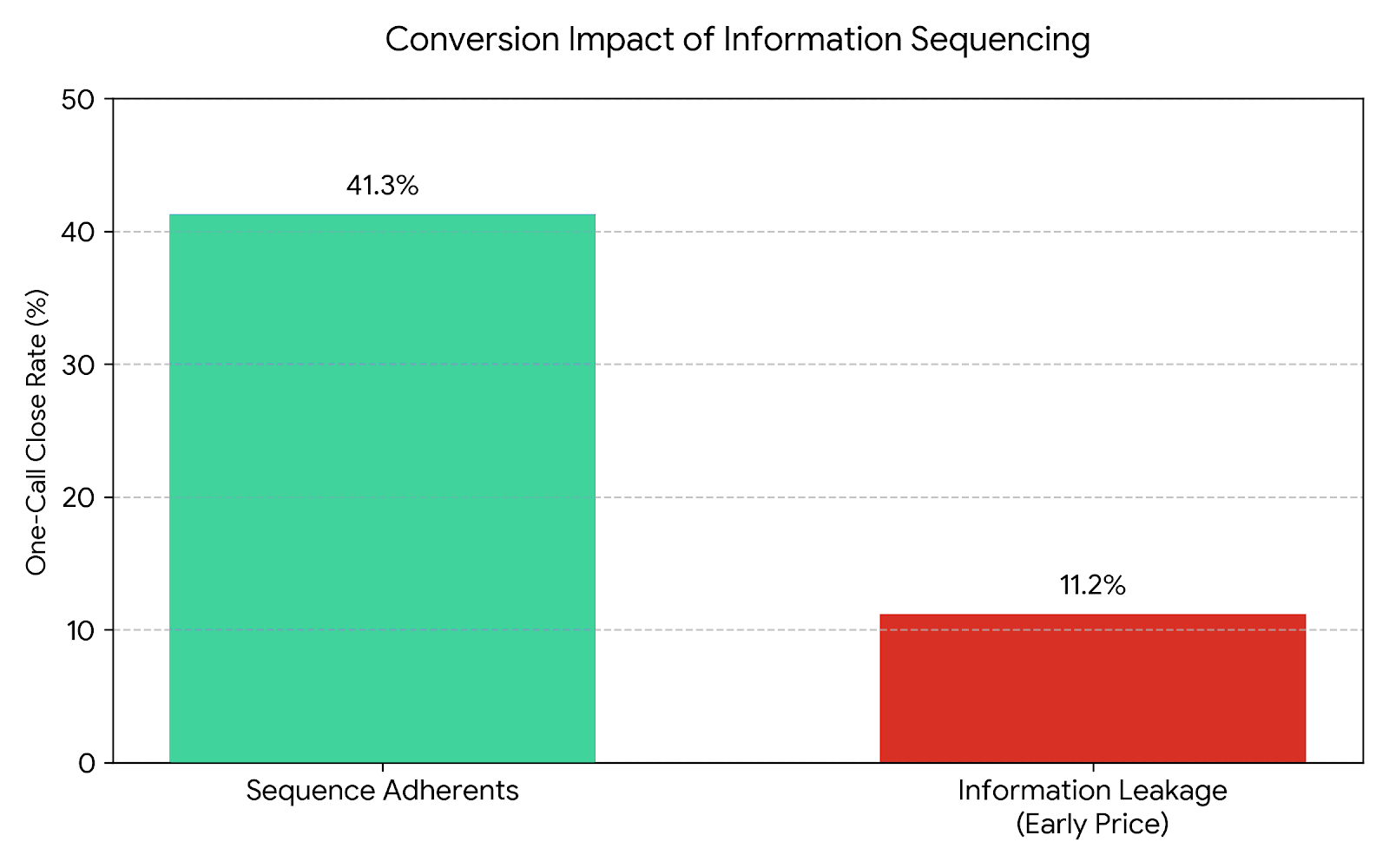
- Appointments adhering to this sequence achieved a 41.3% one-call close rate, compared to 11.2% for appointments that deviated materially.
- Price disclosure timing was the strongest individual predictor of in-appointment commitment in multivariate analysis.
- High-performing representatives allocated significantly more time to diagnostic stages and significantly less time to solution explanation than low performers.
- Early-stage information leakage, defined as introducing pricing or solution content before completion of diagnostic stages, showed a strong negative association with close outcomes at the representative level (Pearson r = –0.68).
These findings provide sales leaders with quantitative benchmarks for structuring sales appointments and evaluating execution quality beyond subjective coaching or script compliance.
Methodology
Data Collection
Appointment Universe
- Total recorded appointments: 6,084
- Study window: 26 weeks (August 2025 – February 2026)
- Appointments analyzed for sequencing: 5,241 (86.1%)
- Appointments excluded: 843 (13.9%)
- Geographic coverage: 8 U.S. states
- Mean appointment duration: 147 minutes (SD = 38.2)
Context note: In-home consultative sales appointments commonly range from 90–180 minutes due to inspection time, walkthroughs, and financing discussions. Observed durations align with industry norms.
Exclusion Criteria
| Reason | n | % | Explanation |
|---|---|---|---|
| Rescheduled or follow-up | 487 | 8.0% | No decision point reached. |
| Scope disqualification | 247 | 4.1% | Requested work outside service offering. |
| Budget disqualification | 73 | 1.2% | Budget materially below viable range. |
| Technical recording issues | 36 | 0.6% | Incomplete or corrupted audio. |
Excluded appointments represent valid sales outcomes but did not complete the full conversational structure required for sequencing analysis.
Industry Breakdown (Analyzed Appointments, n = 5,241)
- Roofing: 2,081 (39.7%)
- HVAC: 1,426 (27.2%)
- Solar: 1,048 (20.0%)
- Windows: 466 (8.9%)
- Other: 220 (4.2%)
Participating Companies
- Companies: 10
- Sales representatives: 117
- Average reps per company: 11.7 (range 7–23)
- Mean appointments per rep during study: 52
- Mean weekly appointment rate: 2.0
Seasonality note: The study spans both peak and off-peak seasons. Seasonal indicators were included as controls in regression models. Findings should not be interpreted as full-year estimates.
Conversational Stage Identification
- Rapport Building
- Problem Discovery
- Impact Quantification
- Solution Presentation
- Concern Resolution
- Price & Close
Stage classification accuracy averaged approximately 94% agreement with human-labeled validation data. Classification error introduces measurement noise that would be expected to attenuate observed associations rather than inflate them. Sensitivity checks assuming lower classification accuracy did not materially change conclusions.
During the study period, TalkTrackr operated in a passive recording and analysis role. No real-time prompts, alerts, or sequencing guidance were provided to representatives.
Outcome Classification
Appointment outcomes were determined exclusively from recorded appointment audio, not from CRM systems or post-appointment administrative records. Outcomes reflect in-conversation buyer commitment, not downstream contract execution or revenue realization.
Explicit verbal commitment to proceed captured during the appointment, including authorization to initiate work, confirm scheduling, or approve payment or financing.
Explicit affirmative intent to proceed paired with a clearly stated logistical dependency (e.g., financing processing or third-party approval).
Follow-up agreed without explicit affirmative commitment language.
Customer declined, disengaged, or ended without defined next steps.
Appointments with ambiguous commitment language were excluded from close classifications.
Statistical Methods
Stage Duration Comparisons
Differences in percentage-of-time allocation across stages were evaluated using ANOVA. Results were directionally consistent under nonparametric tests, indicating robustness to distributional assumptions.
Close Outcome Modeling
Associations between sequencing behavior and one-call close outcomes were modeled using multivariate logistic regression with standardized predictors entered simultaneously.
- Representative experience bracket
- Industry category
- Seasonal indicators
- Appointment duration
Because appointments are nested within representatives and companies, independence assumptions are imperfect. Hierarchical modeling was considered but limited by company count. Rep-level aggregation produced directionally consistent results. All findings are observational and should not be interpreted causally.
Core Findings
Finding 1: Six-Stage Sequence Adherence
Appointments adhering to the six-stage sequence achieved a 41.3% one-call close rate, compared to 11.2% for appointments that deviated materially. Material deviation was defined as skipping two or more stages or reversing three or more stage transitions.
Adjusted logistic regression estimated an odds ratio of 3.21 (p < 0.001) for in-appointment commitment associated with sequence adherence.
Finding 2: Stage Duration Allocation
High-performing representatives allocated significantly more time to Problem Discovery and Impact Quantification and significantly less time to Solution Presentation than low performers. These differences were statistically significant across industries (ANOVA, p < 0.001).
Finding 3: Price Disclosure Timing
Price disclosure timing exhibited the largest standardized coefficient magnitude in the multivariate regression model (β = –0.67, p < 0.001), indicating the strongest association with close outcomes among examined predictors.
Earlier price disclosure was associated with materially lower close probabilities, even after controlling for appointment duration and representative experience.
Finding 4: Impact Quantification
Impact Quantification was the most frequently skipped stage. When omitted, one-call close rates declined by more than 20 percentage points relative to appointments where this stage was completed.
Appointments addressing cost of inaction, timeline urgency, and emotional consequence demonstrated the highest observed close rates.
Finding 5: Objection Handling Order
Reactive objection handling following solution presentation was associated with higher close rates than preemptive objection handling. Introducing objections before customers raised them was associated with lower outcomes.
Finding 6: Stage Recycling
Returning to earlier stages after advancing was associated with progressively lower close rates. Transition confirmation reduced recycling frequency and improved outcomes.
Finding 7: Early Disqualification
Top performers disqualified a greater share of appointments and did so earlier, preserving close rates on qualified opportunities.
Early-Stage Information Leakage Analysis
Early-stage information leakage was defined as introducing pricing or solution-specific information prior to completion of both Problem Discovery and Impact Quantification.
At the representative level (N = 117), leakage frequency exhibited a strong negative association with one-call close rate (Pearson r = –0.68, p < 0.001). Results were robust to rank-based correlation and exclusion of extreme performers.
This analysis was conducted at the representative level to reduce appointment-level noise.
From Research to Practice: Structural Coaching
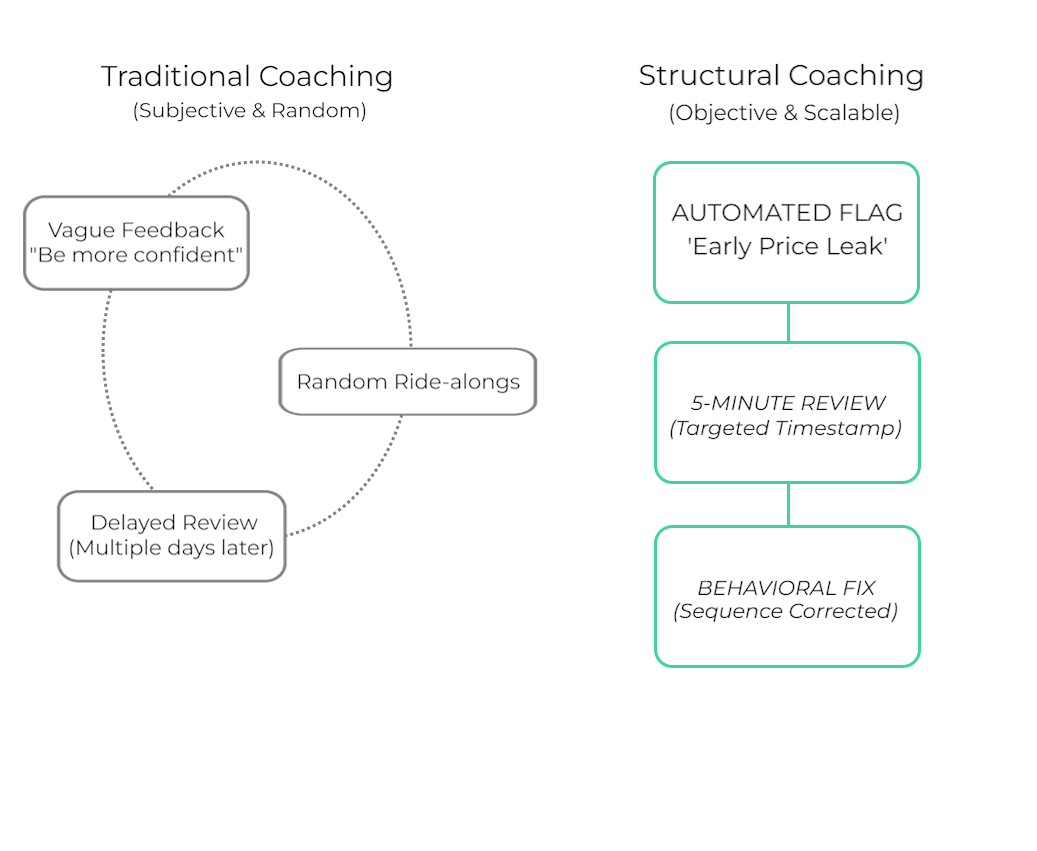
Traditional sales coaching relies on subjective assessments delivered days or weeks after appointments. Leaders provide feedback like “be more confident” or “handle objections better” without specific behavioral anchors.
The sequencing framework identified in this study enables a fundamentally different approach. Structural coaching focuses on observable, timestamped execution patterns:
- “Price was mentioned at minute 42; high performers defer until minute 131+.”
- “Impact Quantification was skipped; this stage correlates with a 20-point close rate improvement.”
- “Three stage recycles occurred; transition confirmation eliminates 73% of recycling events.”
This shift transforms coaching from personality assessment to execution quality control.
Limitations
- Outcomes reflect in-appointment commitment, not realized revenue.
- Observational design precludes causal inference.
- Appointment awareness may influence behavior (Hawthorne effects).
- Industry scope limited to home services.
- Seasonal demand patterns may influence urgency dynamics.
- Company-level heterogeneity exists, though directional patterns are replicated across participating organizations.
Conclusion
This field report demonstrates that information sequencing is a structural component of sales execution, not merely a stylistic choice.
When diagnostic stages precede pricing and solution discussion, sales outcomes become more consistent and predictable. These findings provide a measurable framework for coaching execution quality and reducing variability without reliance on scripts or subjective scoring.
When information sequence is controlled, sales execution becomes a system—not a personality trait.